Summer heatwaves turn many Prague apartments — especially attic conversions or pre-cast concrete buildings (paneláky) facing south and west — into unlivable spaces. While most tenants try to fix this by turning fans to maximum speed, actual indoor cooling is a matter of thermodynamics.
Furthermore, summer introduces specific technical risks for property owners that can cause severe property damage. Here is a guide backed by research from CTU (ČVUT) and UCEEB on how to effectively lower indoor temperatures using physics, and what to look out for regarding technical property management.
01
The Physics of Ventilation: The Night Purification Principle (Night Cooling)
Research by the Department of Building Structures at CTU clearly demonstrates that massive concrete and brick walls act as a thermal battery. If the outdoor temperature is 32°C and the indoor temperature is 26°C, opening a window simply introduces massive amounts of thermal energy into the interior, where walls absorb it and radiate heat all night. Furthermore, turning a fan on in a sealed hot room risks Sick Building Syndrome (SBS) by increasing dust circulation without lowering the room temperature by even a fraction of a degree.
Correct procedure: Keep windows closed and shaded during the day. Ventilation must occur strictly at night and early in the morning (between 22:00 and 06:00), when the outdoor temperature drops below the indoor level. To cool down the building's thermal mass, a cross-breeze with an airspeed of at least 0.5 m/s must be established.
02
Shading Efficiency: Interior Blinds Act as Space Heaters
Measurements by the University Centre for Energy Efficient Buildings (UCEEB) confirm that once solar radiation passes through the window pane onto an interior aluminum blind, the heat accumulates directly within the blind, effectively transforming it into an indoor radiator. Interior blinds intercept only 15–25% of thermal energy.
Effective solution: Heat must be reflected before it penetrates the glass pane. External blinds or shutters are the most effective, reflecting up to 80% of solar energy. If building regulations or historical preservation codes in central Prague prohibit external modifications, exterior solar-reflective window films applied directly to the outside of the glass serve as an excellent technical alternative.
The thermal insulation properties of the window glazing are documented in the Building Energy Performance Certificate (PENB) — worth checking before investing in shading.
03
The Hidden Summer Risk: AC Condensate Overflows
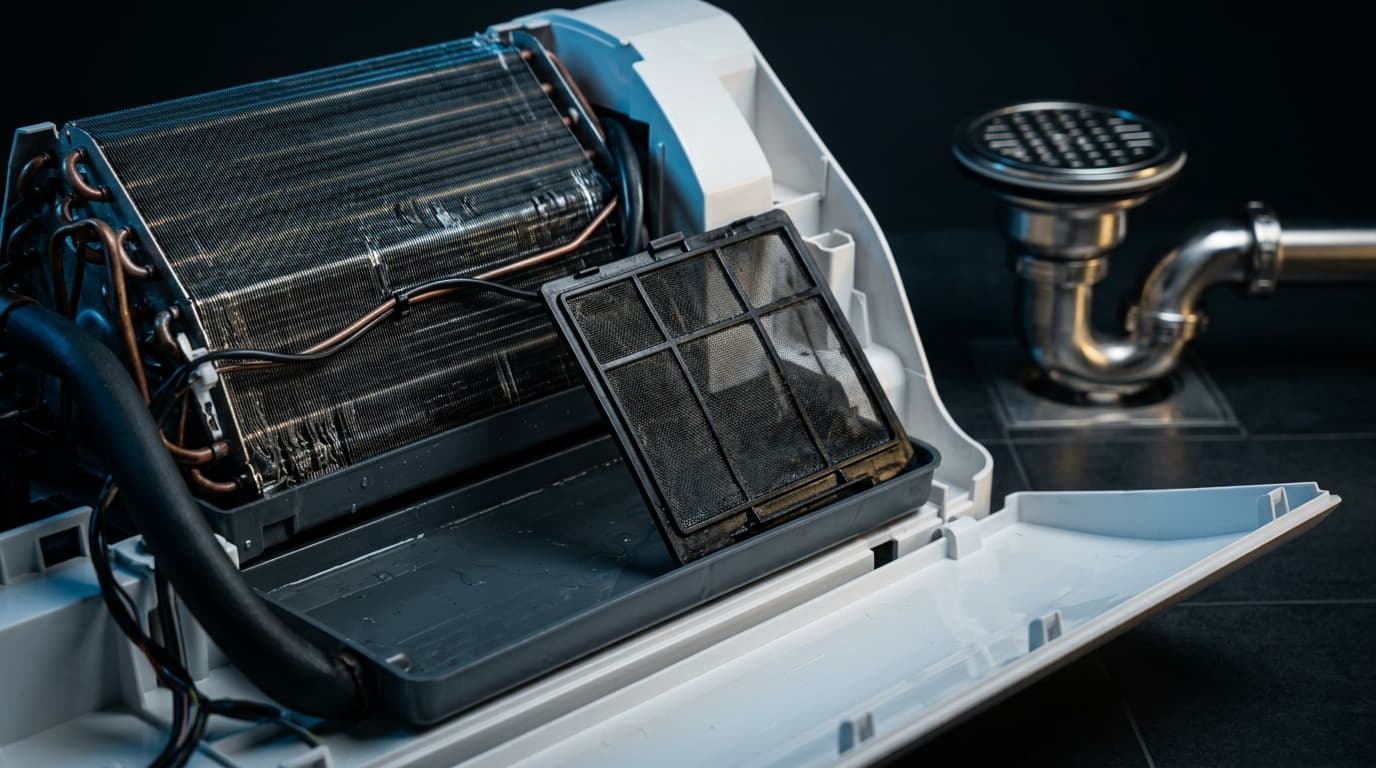
If your apartment is equipped with air conditioning, its operation generates a significant volume of water. A standard split AC unit can produce 15 to 25 liters of condensate per 24 hours on hot days. This water must be drained either via gravity into the building's waste system or via a miniature condensate pump.
Where the breakdown happens: If the air filters are clogged with dust, debris washes into the drain pan and blocks the narrow drain outlet. Water then overflows from the indoor unit directly onto the wall, destroying paint, causing mold, and buckling wood or laminate flooring. Regular pan cleaning and line disinfection prior to summer is a critical technical requirement.
04
Why Does the Bathroom Smell in Summer? Dried Trap Seals (EN 12056)
A frequent summer complaint from tenants is a sewage smell in the apartment. The reason is specified by the EN 12056 standard, which dictates a mandatory water seal height in traps (typically 50 mm). High temperatures and low relative humidity in summer cause rapid water evaporation. This affects floor drains, washing machine traps, and gullies in utility rooms that are not used daily. Once the water barrier in the trap evaporates, sewer gas flows freely into the living space.
The Fix: Simply flush the unused drains regularly with water. To prevent future evaporation, pour a small amount of cooking or silicone oil onto the water surface inside the drain — the oil forms a film that stops evaporation entirely.
🛠️ Keep Your Property Secure All Summer Long
Whether you need professional AC maintenance, solar film installation, or emergency resolution of technical faults exposed by extreme heat, TUTEL is ready to step in. With our technical team on your side, you can rest assured that your real estate asset functions flawlessly in any weather extreme.
Book a technical consultation